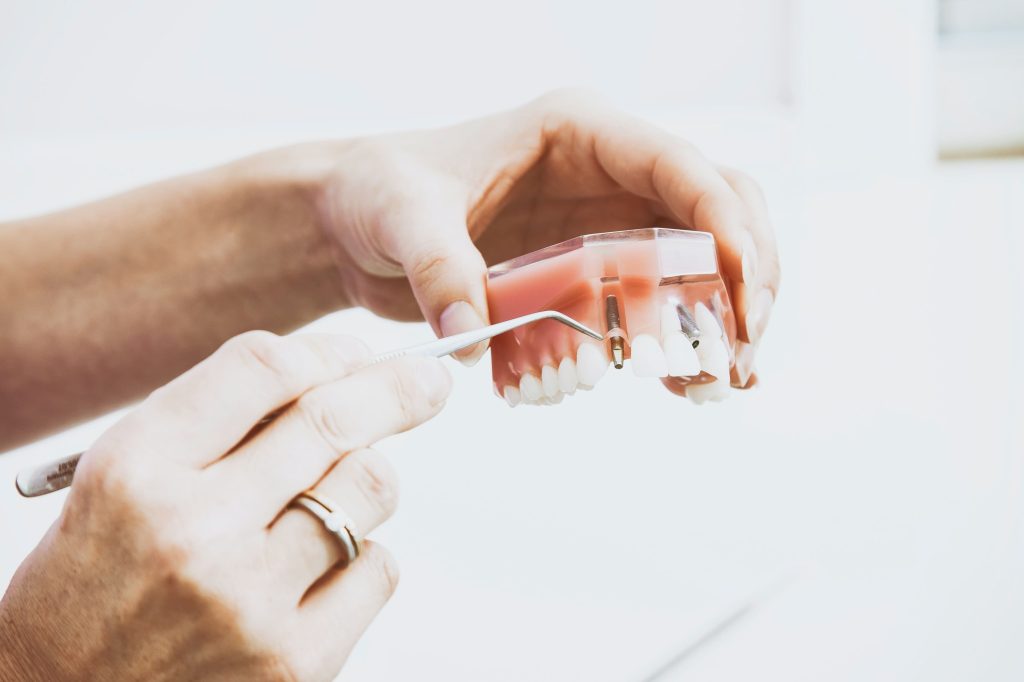
Dental implants
Replacement of Lost Teeth
A dental implant is an artificial root onto which a crown or prosthesis is fixed in order to replace a missing tooth. This artificial root is a small cylindrical screw made of biocompatible materials (titanium or zirconium) that do not cause a rejection reaction and integrate into the bone in a healthy and natural way with the rest of the tissues of the mouth.
After the placement of the dental implant inside the maxilla or mandible and once it is integrated into the bone, the dental prosthesis is fixed by means of a prosthetic abutment.
In some cases in which the implant has sufficient primary stability (strongly attached to the bone), an immediate load can be performed on the same day, that is, a provisional prosthesis (crown) screwed on can be placed. These cases are limited to the anterior sector of the mouth, not to the molars.
From €30/month
Benefits of dental implants
- You will be able to eat again without pain and naturally.
- They will allow you to speak normally again.
- You will avoid bone loss caused by missing teeth.
- They do not affect adjacent teeth; something that does happen with dental bridges.
- You will improve dental aesthetics; you will not see spaces where you are missing teeth.
- They allow for good hygiene, as they are the closest alternative to natural teeth.
At Abaden, we have been
improving smiles for over 40 years.
Process of painless implantology
1. Shade study
The condition of the teeth and gums is examined, as well as their color. We take some initial photographs.
2. Case study
3. Implant placement
4. Healing
The integration period, in which the implants are attached to the bone, is normally 3 or 4 months. However, this depends on the number of pieces to be placed, the complexity of the prosthesis and individual factors of each patient.
5. Definitive prosthesis
6. Control and revisions
Medical team and dental clinics
Specialists in implantology
The professionals who carry out implant treatments in our clinics are dentists specialized in dental implantology and practice their specialty exclusively. For this reason, they have extensive knowledge and experience in this area.
In addition, when assessing a case, these professionals are supported by dentists from other specialties, since the entire medical team meets daily to study each case jointly and thus obtain an accurate diagnosis and a multidisciplinary treatment plan.
Meet our experts in dental implants
Dr. Núria Obradors
Dr. Javier Gastón
Dr. Joaquim Huesca
Dr. Alejandro Manzano
Dr. Coral Isern
Dr. Ana Pla
Main factors that differentiate Abaden from other dental clinics
Experience
At Abaden, we have more than 30 years of experience in dental implantology and more than 3,000 documented implant cases until 2021. The founder of the clinics, Dr. Domingo Obradors, was one of the first speakers of courses for implantologists in Spain and developed and patented the TTFA implant procedure (TeethToday Full Arch®) that is performed in Abaden clinics. In addition, he developed the Clinical Session software program, which allows the daily realization of clinical sessions telematically.
Quality of materials
The implants that we place in our clinics are from the Zimmer and Biomet brands, two of the most reputable brands of medical devices worldwide.
In addition, for the elaboration of the prostheses, we have Corus and other laboratories of great prestige in Barcelona.
Working with top quality materials not only allows us to ensure the durability of the treatment, but also its aesthetic quality.
Dental sedation - Painless treatments
At Abaden, we have a permanent team of medical anesthesiologists led by Dr. Alex Carvi. This allows us, not only to offer the conscious sedation service every day of the week, but also to offer our patients more economical prices on sedations.
Failure rate and guarantee of success
Our implant failure rate is very low. In addition, if there is any incident, we will take care of solving the problem at no cost to the patient.
Dental clinics
Mutual collaborators
At Abaden Dentistas, we work with several medical and dental insurance companies to offer you discounts on most of our treatments and diagnostic tests.
Financing
In our clinics we offer flexible, comfortable and adapted financing solutions to your budget, to help you get the dental treatment you need.
- Financing: Up to 12 months without interest. Up to 60 months with preferential conditions.
- Payment splitting: pay monthly in comfortable installments for the treatment.
- We facilitate a discount for prompt payment paying the entire treatment at the beginning.
- Multiple payment options: direct debit, credit card, cash, transfer, Apple Pay, Google Pay and Bizum.
Frequently asked questions
Is treatment with dental implants annoying and/or painful?
At Abaden we have a permanent team of anesthetists, which allows us to perform treatments under conscious sedation. This technique places the patient in a state of relaxation similar to sleep and, together with local anesthesia, which achieves temporary loss of touch and pain, makes it possible for the patient not to have any type of discomfort during the intervention. If the doctor considers it necessary, after surgery, the patient is prescribed antibiotics, analgesics and anti-inflammatories to avoid possible infections and to alleviate any discomfort you may feel. It is essential to follow the care recommended by the dentist.
Although it may seem like a painful procedure, we have performed this type of treatment many times and our patients are usually very surprised not to notice anything during the surgery and to have a very quick recovery with hardly any discomfort.
What is the recovery like after surgery?
Once the implants are placed, some typical postoperative symptoms may appear, such as:
- Inflammation: it is recommended to apply ice immediately to prevent a lot of inflammation during the two hours following the intervention.
- Bleeding: if the bleeding is persistent, it is best to place a gauze in the area and bite it for at least 20 minutes in order to stop the bleeding.
It is necessary to take into account:
- Brushing: teeth can be brushed normally, always avoiding the area of surgery.
- Rinses: from the day after surgery you can do a type of rinse in the mouth with warm water and salt or with some type of specific mouthwash recommended by the surgeon.
- Medication: if the patient has discomfort, they can take an anti-inflammatory every 6 or 8 hours.
- Meals: you have to wait about 2 hours after surgery to be able to drink something. During the first days, it is best to have a soft diet based on cold foods.
- Tobacco: it should be avoided as it is a risk factor for implants.
Can I get dental implants if I have misaligned teeth?
Yes, in these cases, the patient will normally be offered an orthodontic treatment: Damon or Invisalign; and once the teeth are aligned, the dental implants will be placed.
What are the existing types of dental implants?
You can find different types of dental implants. In each case, the type of dental implant that best suits our needs will always be chosen:
- Subperiosteal implants: are a type of dental implant that is based on metal structures and that are placed in the area on the bone of the jaw, just in the area that is under the tissues of the gums. It is not used frequently but it is very useful in patients who do not have much bone height.
- Pterygoid Implants: are implants that are applied when there is very little bone and are an ideal alternative to bone grafting. These implants are embedded in the apophyses that are in the upper jaw.
- Zygomatic Implants: are screwed and have a varied length of between 30 to 52 millimeters. They are fixed in the cheekbone area and are ideal if there is not much bone in the maxilla.
- Endo-osseous implants: are surgically placed in the maxillary or mandibular bone. Its material is biocompatible and favors its integration into the bone itself.
Another classification that can be given to dental implants is according to their shape. In this case we find:
- Screw-shaped implants: are the most used today because their procedure is very simple and easy to place.
- Cylindrical implants: they have two perforations in the base and make the bone that develops inside take an important firmness with the implant.
- Laminated implants: are made with perforated titanium sheets and make it much easier for bone to grow in the inner area. They are recommended when there is little alveolar bone.
It must also be taken into account that not all implants are the same, that is, they do not have the same quality and therefore will not have the same cost. It is always best to trust the dentist to guide us in the choice of both the type of dental implant and the material of the same.
How are dental implants placed?
To place a dental implant, it takes more or less about 30 minutes, but this time may vary depending on the difficulty of the same. The process will be much simpler as long as there is enough bone. When the expected amount of bone is not available, then a graft must be performed during the intervention.
The phases of placement of a dental implant are:
- Anesthesia: generally local anesthesia is placed in all cases, although in the most complex ones general anesthesia can be requested.
- Incision: a small cut is made in the gum to lift it and thus access the bone.
- Milling/Implant placement: the cavity must be made in the bone to place the implant. In that case, different burs are used.
- Suture: at the end, the wound is closed in order to protect the surgery. Wait about 7 or 10 days to remove the suture.
Is there a possibility that the dental implant will be rejected?
It is important to say that dental implants do not cause rejection in the body. What can happen (although it only occurs in 2% of cases) is that osseointegration fails, that is, that they do not integrate correctly into the bone. The most common cause is peri-implantitis: a disease very similar to periodontitis that in this case affects dental implants. It is an inflammatory process that affects the tissues surrounding the dental implant, affecting its integration and causing a loss of supporting bone. It is usually due to poor oral hygiene after the intervention and causes pain and inflammation.
Depending on the cause that has caused the failure of osseointegration, the implantologist should assess which is the most appropriate solution for the patient. In many cases, the most convenient thing to do is to remove the implant and place a new one in its place.
Clinical cases and testimonials
Our clinics are located in Catalonia
(opening hours from 9 a.m. to 8 p.m. Monday to Friday)
Book your appointment
More than 2,500 happy patients